Thursday, 26 June 2014

‘Managing native pastures for productivity and conservation’

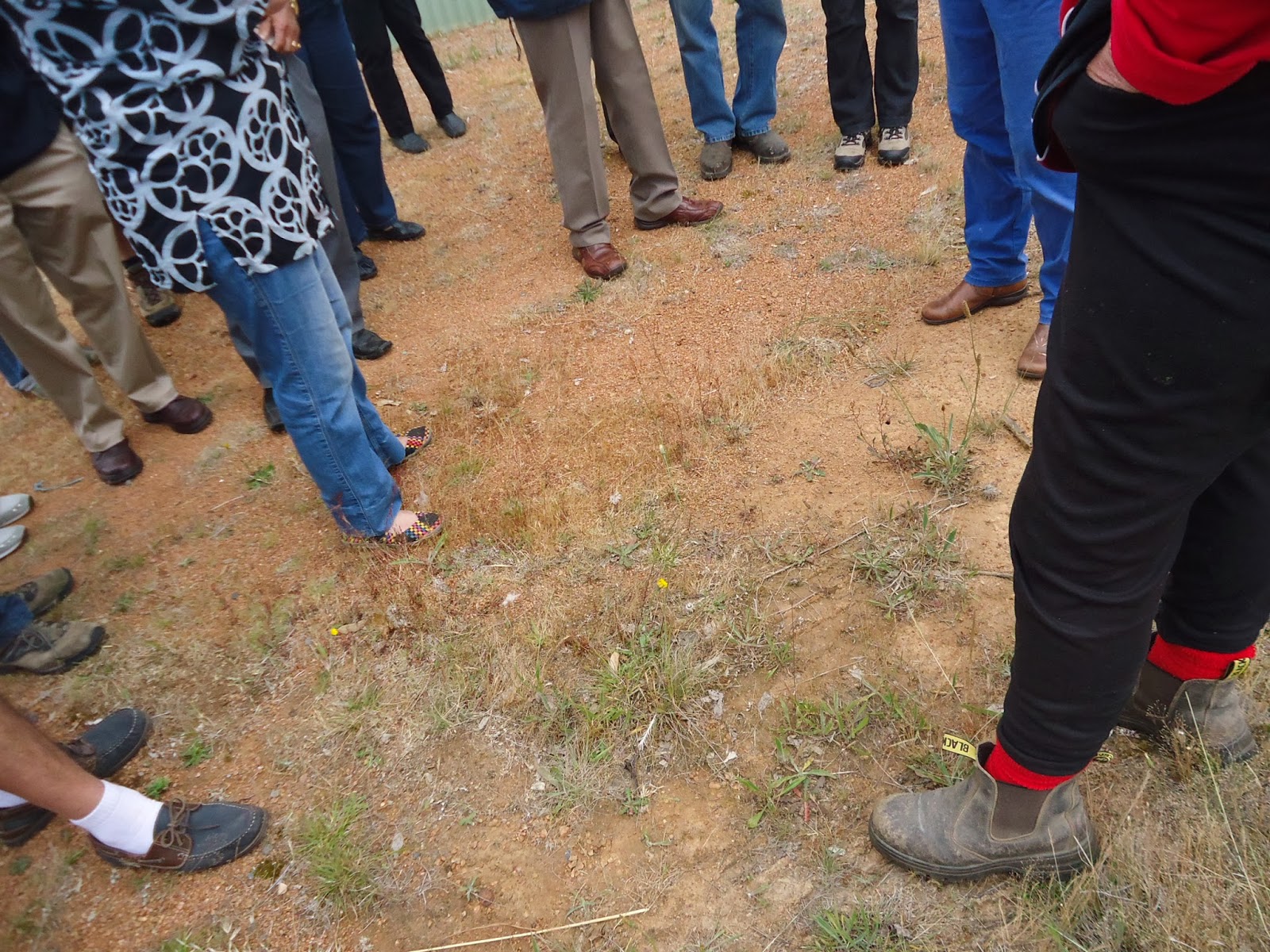
Years of observation, practical farm management, reading and research have given Alison Elvin a large amount of knowledge and strong belief in the value of native pastures for livestock production and biodiversity conservation. She generously shared this with the 22 of us in her attentive and absorbed all-day-workshop class on Saturday 21 June (which started out as a brisk misty Canberra morning; photo above). 

Alison (facing the class in the photo above) explained the seasonality of summer- and winter-active perennial native grasses, and their management via various grazing and burning practices. Native grasses and forbs (many of them leguminous) are finely adapted to the local soils and extremes of climate, adding condition to our meagre soils and protecting them against erosion. Managed native pastures can provide reliable feed through winter, summer and drought, compared to non-native species that can fail in hot dry conditions.

We learnt about native grasses’ use of water and nutrients, their palatability, digestibility and feed value, and their growth habits (mat or tussock). Alison demonstrated many similarities and differences between her samples of native grasses (some are in the photo above) and forbs, and their distinctive flower and seed characteristics, including photos for species no longer in head. Then we walked with Alison and our host John Starr of Gold Creek Station, Hall, into the paddocks to spot grasses, forbs and weeds in real life. We compared the leaf and seed heads of native species to those of African Lovegrass, and Wallaby Grass (Austrodanthonia sp.) to Weeping Grass Microlaena stipoides (photo below) (both were in head in this unusual year), and heard more about managing pastures to boost production and conservation.

Many thanks to Alison, of Natural Capital Pty Ltd, Gundaroo, for her enthusiastic instruction and the handouts, and to John for his hospitality.
Karissa Preuss, catchment coordinator for Ginninderra Catchment Group, organised this workshop and others in the series for landholders and interested others, funded by a Federal Community Landcare grant. 

Saturday, 7 December 2013

Walking the paddock to learn about pasture plants, Saturday 30 November 2013

Understanding plant relations in pastures is a big help if you are engaged in land management. It can mean the difference between healthy nutritious mixed pastures and depressing infestations of weeds such as St John’s Wort.

Knowing when to spray or not to spray St John’s Wort is also useful for avoiding expense and effort for no ultimate effect. 

The more plant species you have in a pasture, the better its grazing value for horses, apparently. Even weeds — whether grasses or broadleaved plants that you would not sow deliberately into a pasture — can be a small part of the mix, so long as they are not dominant (the patch in the photo below has at least three grass species plus the yellow Flatweed/Catsear).


Differing leaf shapes and lengths, times of flowering, annual or perennial, times of best nutritive value, hairiness, spikiness, taste (presumably), type of root, and so on, all can make for an interesting food source for invertebrates as well as stock. A varied combination of species above-ground means potentially efficient exploitation of the soil below-ground, with a range of root types and enzymes and invertebrates in action.

Soil with a complete groundcover should not erode. By definition, it has no bare patches. Bare spaces are the places where weeds (outstanding competitors) can get a ‘toe-hold’. Complete groundcover implies a rich (organic-matter) mixture of roots and their associated insect and microbial activity in the soil. Such soil has pore spaces and overall structure, which the natural plant and microbial exudates help build and maintain. Rain can infiltrate well, and the soil is better able to resist compaction — except where tracks are worn by repeated use.

These are some of the features of plant relations in pastures we learnt on 30 November, during a mild sunny and airy morning with Alison Elvin walking across paddocks on two properties in the Wallaroo area, near Canberra. About 20 local landholders attended this second workshop in the series called ‘Action on Weeds near Wallaroo’, organised by Karissa Preuss of the Ginninderra Catchment Group.

Alison not only identified every plant she saw or we pointed out to her, she also discussed how to plan to attack weeds by slashing, grazing, sowing, mapping the stands of plants in a paddock, cultivation, and the use of biocontrol, where it is available. By making careful observation and notes, a landholder can gradually build up an understanding of plant, soil and animal inter-relations, finding out what management ‘works’ and what does not ‘work’ in particular soil types, aspects and combinations.

This way, spraying with herbicide — with all the associated expense and anxiety — is needed rarely and only when absolutely necessary.

The paddocks we visited had variable proportions of grass species, and some broadleaved species. Among grasses we were shown annuals such as Fescue (Vulpia sp.; see 5th photo below, in the foreground; perennial native Wallaby Grass is near the feet) which are now (in early summer) pale brown or beige in colour . Looking across the hillside we could see patches of Fescue among the green perennials such as Wallaby Grass and Phalaris (once Alison had pointed that out to us!, e.g. in the photo below including on the hillside in the distance).


Mapping (roughly) the annual grasses as they brown off in early summer means that next year you know which paddocks or parts of paddocks to graze heavily during winter when the annuals are green. That way you take advantage of the annuals’ nutritive value, and at the same time you reduce their competitive effect on their associated perennial grasses, so the latter can get ahead.

Wild oats (Avena fatua) were prevalent around these paddocks and roadsides, usually with empty seed heads. Apart from in crops, infestations of wild oats are mostly a worry because they are a considerable fire hazard in summer when they are brown and dry, Alison told us. If you graze this grass heavily when it’s in leaf during winter, before flowering, the flowering stalks will be shorter in spring and the infestation will be less of a fire risk later.


Yorkshire Fog (Holcus lanatus; top photo below), Phalaris (Phalaris sp.; photo above), Couch (Cynodon dactylon) and Hairy Panic (Panicum effusum), Barley Grass (Hordeum leporinum; tufty, in foreground, lower photo) and Ryegrass (Lolium sp.; ridgy flowerhead, around shoe in lower photo) were other introduced grasses we saw, and of course African Lovegrass (Eragrostis curvula).


Two paddocks were well populated with Wallaby Grass or White Top (Austrodanthonia sp.; photo below, near the feet), apparently so called because the flower head has white hairs as on a wallaby’s face. Weeping Grass, Microlaena stipoides, was also seen. Both can tolerate a small to moderate level of soil phosphate: more than other native grasses, but still not much. Alison said it is preferable to build up the soil fertility gradually, over several years, by applying compost tea, rather than superphosphate.


Among broadleaved species Alison told us how to manage Capeweed (Arctotheca calendula); Paterson’s Curse (Echium plantagineum) —‘paddo’; Flatweed (Hypochaeris radicata); St Johns Wort (Hypericum perforatum) — ‘SJW’ (photo below). Alison advised that if SJW or Paddo began to invade from the denser patches visible nearby then to dig them out or cut them down quickly, or smother them with a pile of straw or similar mulch material. It’s important to act decisively at this time of year when the prolific flowers are beginning to set hundreds of seeds.


We learned that SJW has strong rhizomatous roots as well as multitudes of seeds to help it invade. Spraying it can be a huge waste of money — though it can be useful if done at a suitable growth stage. Alison says that early summer is the ideal time, when the SJW is in flower and easy to see. Although some of the flowers may have started forming immature seed, generally spraying in early summer will achieve an excellent kill rate, and the seeds will not mature further, and little or no new seed will be produced. 


(The wrong time to spray is, for instance, when the flowers are nearly finished and are full of seed. At that late stage you will not prevent the next year's 'crop' of this weed, although you would kill the plant.) 

The risk with spraying at the wrong time is that you will kill much more than just the SJW (which could leave bare patches for new weed invasions) and you could spend hundreds of dollars and end up with as big an infestation the following year.

Other control methods Alison discussed were burning, slashing and biocontrol. Burning and spraying too late (as above) can work but only because in the following wet season you can expect a thick germination of young SJW from the hundreds of unkilled seeds, which you can immediately destroy by cultivating (or perhaps spraying).

Biocontrol is an exciting possibility. The controlling beetles, released deliberately by local entomologists in one of the paddocks we saw, have killed a whole slope of SJW - the browned off plants behind the people in this photo below. Only a few individuals (flowering) remain in this stand. 


The beetle used in this area of NSW is Chrysolina quadrigemina (photo above) though other species appear to have been released in the Cooma area further south (http://www.cooma.nsw.gov.au/files/docs/environmental_
management/noxious_weeds/factsheets/St%20Johns%20Wort%20CMSC%20Factsheet.pdf
). If you have the beetle, Alison advises spreading individuals as widely as you can into your own SJW patches and into your neighbours’ as well. You should let it get on with eating your SJW (the adult does the damage) and not attempt to otherwise control the SJW at the same time which would remove the beetles’ food supply.

We saw little Paterson’s Curse, but plenty of Flatweed (or Catsear). Alison pointed out its differences from Dandelion (Taraxacum sp.). Flatweed causes problems for horses (but not other stock). Dandelion on the other hand, with its distinctively hollow stem and only one flowerhead per stem, indicates good nutritional status in the soil.  

Other photos from this 'walkshop' and the previous workshop on 10 November are in the pages at the side of this blog.


Monday, 25 November 2013

Paddock weeds in the farms of the Ginninderra Creek catchment, NSW

“Where a weed can grow, a plant can grow,” I was told once, years ago, by a senior CSIRO scientist. I thought he meant that a weed prevents a desirable (‘good’) plant growing in the same spot, or that if a weed can grow ‘there’ then that soil must have qualities that good plants could exploit too, if their seed had been there first. But perhaps he was referring to the paradox below which occurred to me after Alison Elvin’s workshop on 10 November.
Alison, who is a rural educator and local farmer, gave a comprehensive overview of weeds management to an attentive and responsive group of southern NSW landholders. The whole-of-a-Sunday session was the first in the series called ‘Action on Weeds near Wallaroo’, run by the Ginninderra Catchment Group. It was held just outside the ACT at the Wallaroo Fire Station, on a day that became very wet, with the fire engines quietly asleep in their adjacent shed after the previous spell of hot dry weather and destructive bushfires. 
The landholders first outlined weed issues that were worrying them (which Alison noted on a board: photo below), and several brought examples to be identified. In exchange they heard about possible reasons for the infestations, and a number of ways of managing land and livestock to deal with weeds and avoid reinfestation.

As Alison pointed out, in our brief time outside, if there is bare ground in a paddock (or garden or anywhere else) then a weed is the most likely type of plant to move in. Paddock weeds have trouble growing where healthy ‘good’ paddock plants are offering strong competition, so if there are bare patches on your land you can expect paddock weeds to grow there!


Although we heard about weeds’ competitive features, Alison also told us some of their ‘benefits’, such as … fat tap roots which open up the soil (e.g. Paterson’s Curse Echium plantagineum); ability to mobilise cations out of the soil matrix, such as copper (Paterson’s Curse/Salvation Jane) and calcium (Capeweed Arctotheca calendula); and the way some weeds reveal soil character by their presence, with thistles for example apparently showing that the soil is well structured, and Serrated Tussock (Nassella trichotoma) protecting the ground so well that the ‘best worms for fishing-bait’ may be found beneath it!
As competitors, weeds excel — as we know! — and this is because, Alison said, weeds include plant species that can flourish in low-nutrient, acidic (comparatively rich in aluminium ions) compacted soils (therefore few pore spaces and little oxygen, water or microfauna). Weeds succeed also because they often have a strong and fast growth pattern, cover the ground with rosettes of leaves, flower vigorously, have lots of pollinators and few predators and are able to send plentiful seed out to new ground. On that basis, Serrated Tussock seems to be an ideal example weed, judging from the NSW Dept of Primary Industries webpage at http://www.dpi.nsw.gov.au/agriculture/pests-weeds/weeds/profiles/serrated-tussock:
“Serrated tussock is a perennial, drought-resistant, highly invasive tussock-forming grass which is a serious weed in Australia, New Zealand and South Africa. It is highly adapted to a range of environments, seeds prolifically and is difficult and costly to control. Large volumes of seed are spread long distances by wind; allowing new populations to establish over large areas.”
Here is my paradox. If you have bare ground which offers too little amenity for pasture species to survive, then the weeds that move in may improve it for you. If the soil is compacted, those invading weeds will force their roots through it, creating pore space. If it is deficient in minerals, weed roots may draw them up from deeper horizons; the minerals will then become available in the topsoil when the plant parts die and fall. Weed plants supply organic matter to that previously bare ground, and protect it from wind and water erosion. Once you remove the weed, the ground could well be in better condition for other plant species. (Note: be sure to spread desirable seed there immediately, and/or mulch.)
All that makes me wonder why we define weeds as ‘plants that grow where they are not wanted’. Perhaps we just don’t know what is good for us! Is this what my CSIRO colleague meant, years ago?
Another odd situation is that while paddock weeds in many cases are non-native to Australia, so too are many of our favourite pasture and crop species! Paddock weeds, then, are mainly non-native species that are not valued for grazing or harvesting here? (This is probably also the case in England, for example, where many similar mixtures of species are likely to be similarly classed as pasture, crop and weed.)
If our pastures comprised mainly native species, like our bushland, then non-native invaders would be more understandably weeds. ... Actually, though, Alison pointed out that native grasses such as Kangaroo Grass (Themeda triandra) and Weeping Grass (Microlaena stipoides) make good pasture grasses …
Alison’s whole-day overview was based on her own and others’ experience and reading across a large literature ranging from official ag-department information to traditional northern hemisphere knowledge about species. Her workshop introduced thought-provokingly creative ways of managing weeds; and although she did touch on the use of herbicides, we were told that considerable weed-control has been achieved via non-herbicidal whole-land management on her own farm.


Whole(some) land management, we heard, can include annually mapping the weeds (including their density) on one’s land in relation to topography, watercourses, neighbours (weeds on high land are more likely to blow next door), other vegetation and grazing. Timed management of livestock, as well as type of animal (donkeys and goats eat weeds other stock reject), and cultivation, slashing, burning, chipping out, mulching, and scattering desirable seed to change the balance in the seed pool, all have their place in Alison’s portfolio of weed control methods.

I recommend attending a workshop by Alison Elvin if you are interested in weed ecology or economic botany or land management, even if (like me) you are not a landholder. Her rural education and native seed business is Natural Capital Pty Ltd, based at Gundaroo, NSW. Alison will be leading a paddock walk, also in the Wallaroo area, on 30 November to show us how to identify (and perhaps map) weeds in the paddock. I aim to be there, if at all possible. 

Saturday, 23 November 2013

Cane Toads and Indian Mynas – they don’t know they have to die!

Cane Toads (Bufo marinus) are introduced pests and a key threatening process under the EPBC Act (1999), but killing them should still be done humanely! — and without damaging the water or ground they are in or on at the time.
Pest control was a frequent topic of conversation at the Floriade Bush Friendly Garden (BFG) (see previous post) because of the garden’s theme of replacing and disposing of pest plants. There was also a Myna trap on display, showing the wire-cage design that has successfully been catching Indian Myna birds in ACT (for humane disposal). These cages are available free or to build yourself from plans provided via an internet link, http://www.indianmynaaction.org.au/trapping_help.htm.


(In these photos of the Myna trap, the snake is an ornament attached to the fence, and nothing to do with the cage/trap.) 
Visitors seeing the Myna trap at the BFG naturally then told us their own or their neighbours’ experiences with trapping Indian Mynas. The conversation sometimes extended into ways to manage or kill other pest animals. I heard how people deal with Cane Toads, snakes and possums, and I reciprocated with our family’s method for small ants invading the kitchen food cupboards (spray them with Vanilla Fridge-wipe and sweep up the bodies).
One weekend I was told that spraying an adult Cane Toad on the back with Dettol kills it quickly: “Three hops and it’s dead”. However, the person, from Queensland, warned that the liquid should only be applied as a gentle stream (not spray), because it will kill the grass around the toad as well if you‘re not careful.
A check on the web shows that this is very true. Dettol is a poison, and it poisons the environment. It is prohibited for use, the person told me, in jurisdictions such as WA.
Humane ways are available for killing Cane Toads. The webpage of the RSPCA knowledge base looks like the one to visit first to find out about them. See: http://kb.rspca.org.au/What-is-the-most-humane-way-to-kill-a-cane-toad_299.html.
That RSPCA page recommends Hopstop® as the best method. It says:

“
Hopstop® is an aerosol spray that has been specifically developed for killing cane toads and is now commercially available for this purpose. When applied in sufficient quantity it appears to be an effective, easy to use and relatively humane method.”
Other webpages look responsible and informative, too, though the ranking of humane methods can vary.
For example, the webpage at http://www.frogsafe.org.au/cane_toads/dispose.shtml points out firmly that:

“just because the toad is a pest, this is NO EXCUSE for animal cruelty and sadism. The toad doesn't know it's a pest and it feels pain like all other living animals. Cane toads should be killed humanely and this means methods which invoke the least amount of pain and stress.”
That ‘frogsafe’ webpage (which is part of a website devoted to amphibians in Queensland) also emphasises that you need to be sure you are accurately identifying Cane Toad eggs, tadpoles or adults. If you are certain, the 'frogsafe' webpage continues, then:
“For example, you can pull their eggs out of ponds and dams; you can scoop up tadpoles with aquarium nets and you can hunt for young toads and adults. You can volunteer to join organised groups who are working to clear cane toads from a particular site...”
A webpage at http://www.canetoadsinoz.com/killingtoads.html warns against using Dettol.
I like the look of the fridge/freezer method, reminiscent of lulling crayfish to sleep in warm water before boiling them (if you can catch them, as in Gary Clark’s ‘Swamp’ series of cartoons). But the fridge/freezer does not apparently kill as humanely or as thoroughly as Hopstop.
The Australian Government Department of Environment has a policy on Cane Toads, at http://www.environment.gov.au/biodiversity/invasive/ferals/cane-toads.html. The webpage explains that because of the poison sacs on their shoulders, Cane Toads are an ecological threat to carnivores including quolls, snakes, goannas and crocodiles that prey on them. They also threaten the existence of other native species such as frogs, presumably by competition for food sources.
Children and pets are also at risk if they contact the toads’ poison.
The policy does not seem to offer ways of controlling individual Cane Toads. 

Thursday, 3 October 2013

Bush Friendly Garden at Floriade

The Bush Friendly Garden is at Floriade again this year, tucked away in a corner, where you may easily miss it.

This informative display is not brightly tulipped and hyacinthed. Instead it shows visitors a range of environmental weeds commonly grown in gardens, and a collection of beautiful non-invasive flowering shrubs and groundcovers that can be grown instead. Many visitors are interested and sometimes amazed to find out that their ivy, periwinkle, olives, Cootamundra wattle, broom, gazanias, privet, special grasses and other plants are unwelcome when they escape the garden and invade native bushland.

Plants that are environmental weeds can (and do) grow prolifically and swamp other vegetation. They are spread by birds eating their fruit (think olives, cotoneasters, currawong poo full of orange firethorn berries or purple privet berries), or their seed may blow around easily or be readily carried by dogs and feet (think fur and seedy socks) and mowers and other means. 

Most people are fascinated to see and photograph the non-invasive alternative plants in this bush-friendly garden (BFG) at Floriade. Among these ‘good’ plants on show this year there is an unusual ‘standard’ (grafted) casuarina, and a ‘standard’ (grafted) grevillea. There are cushion-like plants, and soft ferns. There is a young Wollemi Pine, and a native indigo (Indigofera sp.), as well as an eye-catching smokebush with violet flowers — a very attractive combination — and other garden beauties.

The ACT Parks and Conservation staff members assemble this garden each year, using potted plants arranged as if in flower beds and adding decorative ‘critters’ — for example snakes and beetles (only models!) — to interest children. There are takeaway brochures, and staff who chat with the visitors who come from all over Australia, overseas, and (we hope) the local region. The more the people from this region who recognise local environmental weeds, the higher the likelihood that, gradually, local gardens will be cleared of these species and filled instead with attractive non-invasives (preferably some that will attract birdlife). Reducing the environmental weeds in gardens in turn will help prevent these repeat offenders — that is, the weeds — from requiring continual control work in local bushland and national parks.

Each year the ‘BFG’ garden is slightly different, with different alternative (good) plants and often a different arrangement. In past years the ‘good alternatives’ have been adjacent to similar ‘bad’ plants — the invasives — reflecting the pattern used in the booklet Grow Me Instead published by the Nursery and Garden Industry Association (it is also on the web: Google ‘Grow Me Instead’). This year, like last year, the bad plants are in one half of the display area and the good plants in the other.

This year, there is a lectern at the entry to each half of the area, with a rain-proofed book showing a photo and notes about, and the location of, each plant that is on display in that half. This is very helpful because many visitors are keen to know more about the plants and the volunteer staff (at least) cannot always help.

Staffing the garden remains an important means of telling visitors about environmental weeds, even though the arrangements of plants and signage give many visitors the clues they need to interpret what they see. You do really need to be a bit aware of pest plants and gardening to ‘get it’ without explanation.

Staff members from ACT Parks and Conservation are there, with volunteers, during weekdays. At weekends, only volunteers staff the garden. We come from a range of interests: some of us grow native plants, some are Friends of the national botanic gardens, some are ornithologists, others help with Weed Swap — the twice-yearly day when you can take a load of environmental-weed shrubs to one of two ACT green-waste dumps and get a small native plant in a tube in exchange. Others do Landcare work, clearing these weeds from the bush. All of us are contacts of Ms Rosemary Blemings, who is tireless in her conservation and environmental work in the ACT.

We enjoy listening to the stories our visitors tell us. This garden is a wonderful way to hear about gardening and pest control across Australia; this may be the only part of Floriade where a visitor can hold forth to an interested audience, rather than ‘tiptoe[ing] through the tulips’ (and the amazingly fragrant hyacinths and daisies and irises and…)!!

We hope this year to find out if visitors appreciate our 'BFG' and are understanding our message clearly, via a survey. One lucky respondent will win a gardening book after Floriade is over in October.

If you are at Floriade, do look for the kangaroo pond and then track down the ‘BFG’. It is near a big white marquee where cooking is demonstrated, and beyond the garden about permaculture with chooks, wicking beds and very healthy vegetable seedlings. Mr Costa Georgiadis visited that garden last weekend, and maybe he will call in on us one day. We hope so.

Footnote:
Mr Shane Rattenbury, MLA, has visited the garden and he sent out this Tweet: Shane Rattenbury ‏@ShaneRattenbury24 Sep Just checked out the Bush Friendly Garden at #Floriade #canberra - great ideas for non-invasive garden plants pic.twitter.com/UngmXQJZUg

Sunday, 11 September 2011

Environmental weeds: Trying for ivy control - and how many berries does it take to grow a bush?

During June-September, many berries have been cut off non-Australian bushy shrubs in this area, both in our garden and out in the native bushland and parkland where I help on the Landcare teams. So many bushes of privet, cotoneaster, briar rose, hawthorn, with so many hundreds of berries.

It made me think - why aren't there hundreds of seedlings of these shrubs springing up all over the place, having sprouted from the berries dropped by the bush and by birds?

Perhaps the reason is that a large proportion of berries are eaten and digested before the seeds in them can germinate. In her blog* in July this year, Rosemary (Mt Rogers Landcare Coordinator) writes that she watched silvereyes (small native birds) and mice eating cotoneaster berries. I've noted before that native parrots (crimson rosellas) and currawongs (native raven-type birds) almost queue up to eat the berries - for example, there were five currawongs one day, taking turns on the last bunches of privet in our garden! One can assume that some berries will be collected by insects such as ants - except that ants don't come out very much, if at all, in the cold winters we have here in Canberra.

Anyway, I've decided to do some tests. I've reserved bunches of privet berries and handfuls of cotoneaster berries from our own garden bushes, stored them on the back step in the normal weather, and today (11 September 2011) I've set them into shallow trenches, covered them with soil and watered them.

My idea is to see if seedlings emerge - in a mass, or just a few - and how long it takes. This is a very rough test, and if anything grows I intend to do a more scientific assessment next year.

Ivy is another pest plant that is rampaging - in a creeping sort of way - across the garden here. Like everyone else, I want to find a way to control it, so I've set up two tests so far. The first was simply to strip the growth off a gate post where it was so well established it had grown berries! The stripping took place in mid-winter, when the ivy was probably not growing fast. In the same few days, I also began the second test: thoroughly spraying the leaves of ground ivy with Roundup (proprietary herbicide) and then immediately (within a minute or two) covering the sprayed leaves with a thin layer of mulch.


The results of the stripping are encouraging. (They are a repeat of my experience in another garden where I just pulled the ivy out and off the side of the house, and also pulled out any regrowth later. Excellent control.) Only one stem of ivy remains on the gate post (it was inaccessible to my stripping in July-August), and it has a few new shoots on it now, as we move into spring.  Provided I hook that stem out soon somehow, I expect that growth to come under control easily.

The results of the spraying and covering are negative. The mulch has been breached in a few places by big ivy leaves, and where I pull the mulch back to look beneath it, there is healthy ivy waiting to burst through. However, grasses and other weeds that were sprayed along with the ivy are very dead.

The next test will be to apply two sprays: first a detergent solution, using the detergent from the kitchen for dishes, followed quickly afterwards with a spray of Roundup. It'll be important not to make the leaves too wet with the detergent. The detergent is supposed to break through the waxy coating on the leaves so the Roundup can penetrate into the plant tissue. But if the leaves get too wet the Roundup spray will probably just run off.

When attacking woody weeds in bushland, the Landcare teams work in pairs: one person clears around the stem of a weedy shrub, and then, when the other person with the Roundup bottle is ready, they cut the stem and 'dab' it with Roundup within seconds. That method works very well and should work for ivy - but imagine having to dab every small ivy stem! I've heard that for ground ivy you can run the mower over it and then spray (with a drop or two of detergent in the spray bottle). But again I think that needs to be a 2-person job, with one mowing and one spraying within seconds of the mower passing.

If ivy was coming into our garden through a fence or some similar barrier from a neighbour, where the fence acted as a sort of filter, it should be manageable to cut a small cluster of stems and spray them within seconds with Roundup (again with detergent added).

If successful, that could be a drawback to neighbourly relations. Roundup is supposed to kill the plant right down to the roots. So I might achieve the ivy-control I wanted but lose the friendship of my neighbour - assuming she liked to have ivy growing on her side of the fence. Tricky!

For the rest of the rampaging ivy here, I plan to pull it up and then watch for and pull out the regrowth. It should be a simple and effective way to get this weed under control this spring.

*www.mtrogerslandcare.blogspot.com

Tuesday, 24 May 2011

Environmental weeds: Merrily berrying!

“A berrying we will go; a burying we will go....”   Well, not the second kind of burying, actually.
It’s remarkably easy and quick to cut the berries off the woody environmental weeds that are flourishing in our garden and in local patches of bushland.

On Sunday, in a 2-hour ‘weeding bee’ on Mt Rogers*, 8 people snipped off enough berries on twigs to fill a box trailer (with cage), packed tight, to about 1 metre deep. Just using secateurs or loppers we completely harvested the red and purple berries on bushes of Cotoneaster (Cotoneaster species), Hawthorn (Crataegus monogyna), Briar rose (Rosa rubiginosa), and Privet (Ligustrum species). These woody shrubs, viciously prickly in the case of Hawthorn and Rose, have been taking over the hillside where we were working, shading out and crowding native shrubs and grasses.

There were signs that kangaroos have been roosting under one of the Privet/Hawthorn tangles, and again elsewhere under a dense Cotoneaster bush. But they can go on doing that — we only cut off the berries on Sunday; the main structure of the bushes is still there, though more open to let light through.
Autumn is the time when the berries are present and obvious, and easy to remove before the birds eat and spread them out everywhere to germinate in spring. Once spring comes, we will return to these bushes, cut the stems near the ground and dab them immediately (within 5 seconds) with weedicide. That is the best way to kill the roots, it seems, to get rid of the plants altogether.

After we’d all had a break for a cuppa and a welcome muffin, the trailer’s owner set off for the green-waste tip, taking the yield of our 16 person-hours of work.


Weeding bees once a month are a rewarding way to spend a couple of hours outdoors (especially if it’s not raining) giving oneself a glowing sense of goodness!!
In fact, I personally think that community working groups are an excellent way to tackle weed control, for species that don’t need to be sprayed in large areas (such as grasses). The more community members who join in, the more that can be done, of course. If the job were to be left entirely to government employees, it would be very costly to pay enough of them to control the woody weeds, because though easy work it’s labour-intensive.

*Mt Rogers, in the north-west part of Australian Capital Territory, is a mound 704 m above sea level (at the top), derived from volcanic activity 425 million years ago (or thereabouts). It is crowned by native bushland, and entirely ringed by suburban gardens, .and it offers fabulous views of New South Wales and Canberra. 


(Vehicles were only allowed onto this track for the working bee.)